Reading the tiles: a short guide to Timurid architecture
A few words and a few habits of looking that turn a wall of blue into something you can read: the parts of a building, how the colour went on, what the scripts say, and which tiles are old.
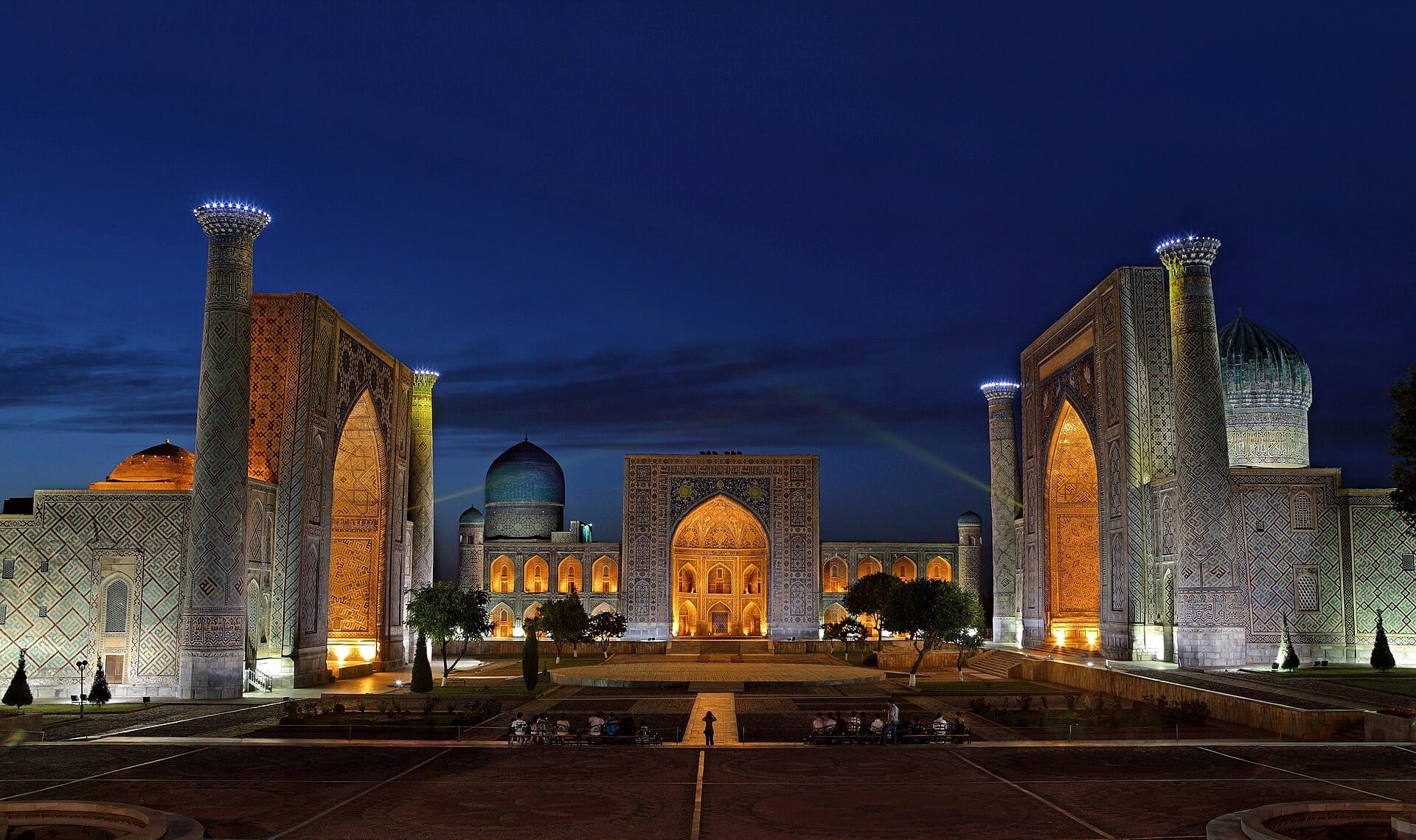
The first sight of the Registan is a wall of blue, and for a few minutes it is enough. Then the eye wants more than colour. The style is Timurid, made for Timur and his grandson in Samarkand in the late fourteenth and fifteenth centuries, and the buildings that came after kept its grammar. A madrasa is made of a few parts, the colour went on in one of three ways, the writing says something, and the patterns follow rules. A few words and a few habits of looking are enough to begin reading; the guide beside you does the rest.
The plan of a building
Start with the portal. The pishtaq is the great rectangular frame that rises above the roofline with a pointed arch cut into it, the part meant to be seen from a distance. Behind the arch is the iwan, a vaulted hall open on one side; the portal is an iwan turned to face the street. Beyond it is the courtyard. In a madrasa the court is lined with small cells, the hujras, usually in two storeys, with a larger iwan in the middle of each side.
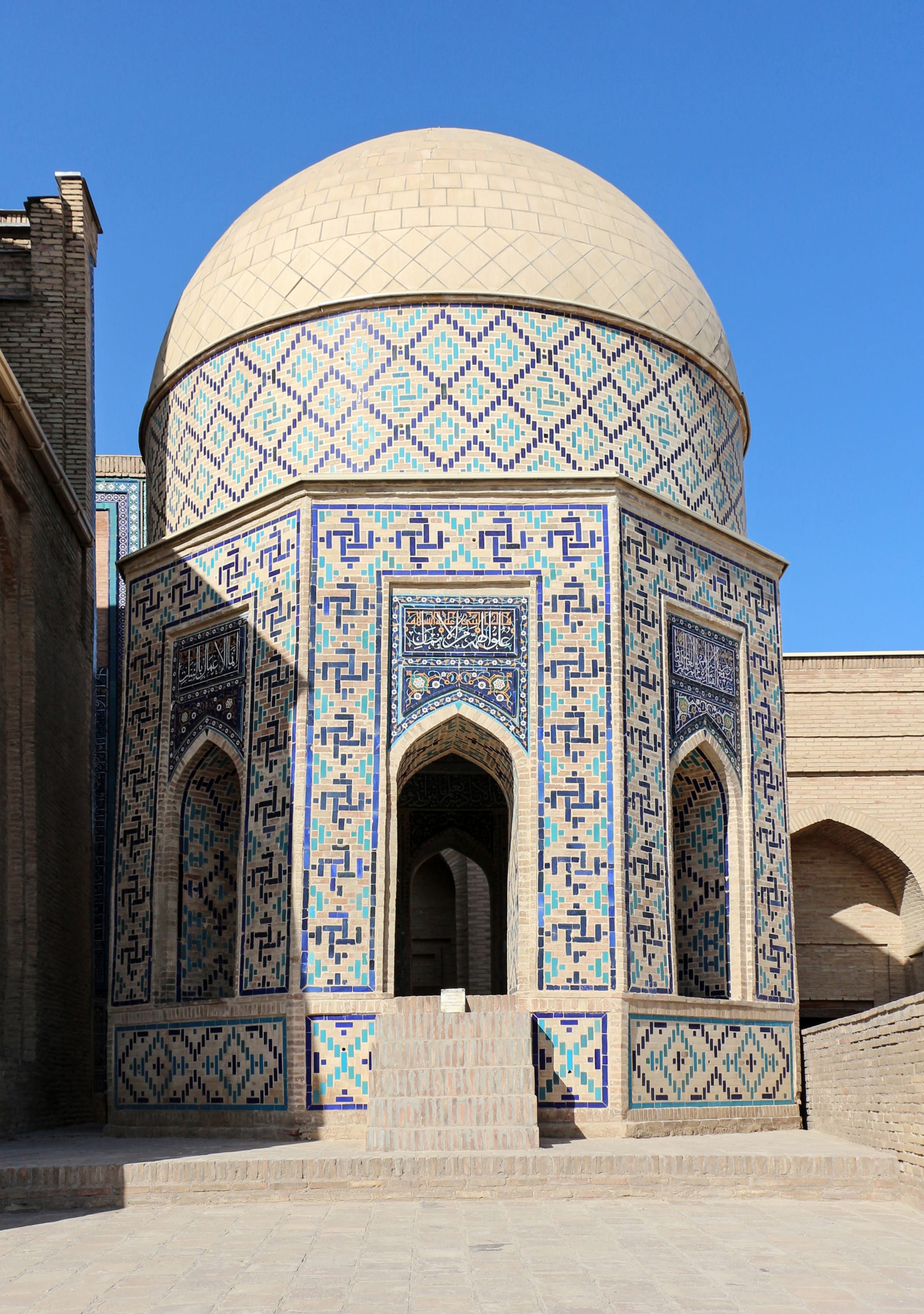
Above is the dome, and under the dome a drum, the tall cylinder that lifts it clear of the roof and carries a band of script round its waist. Look up as you pass under a portal. The honeycomb of small niches in the half-vault is the muqarnas, and it exists to catch the light: each cell takes the sun at a different angle, so the vault reads as something between stone and cloud.
Three ways the colour goes on
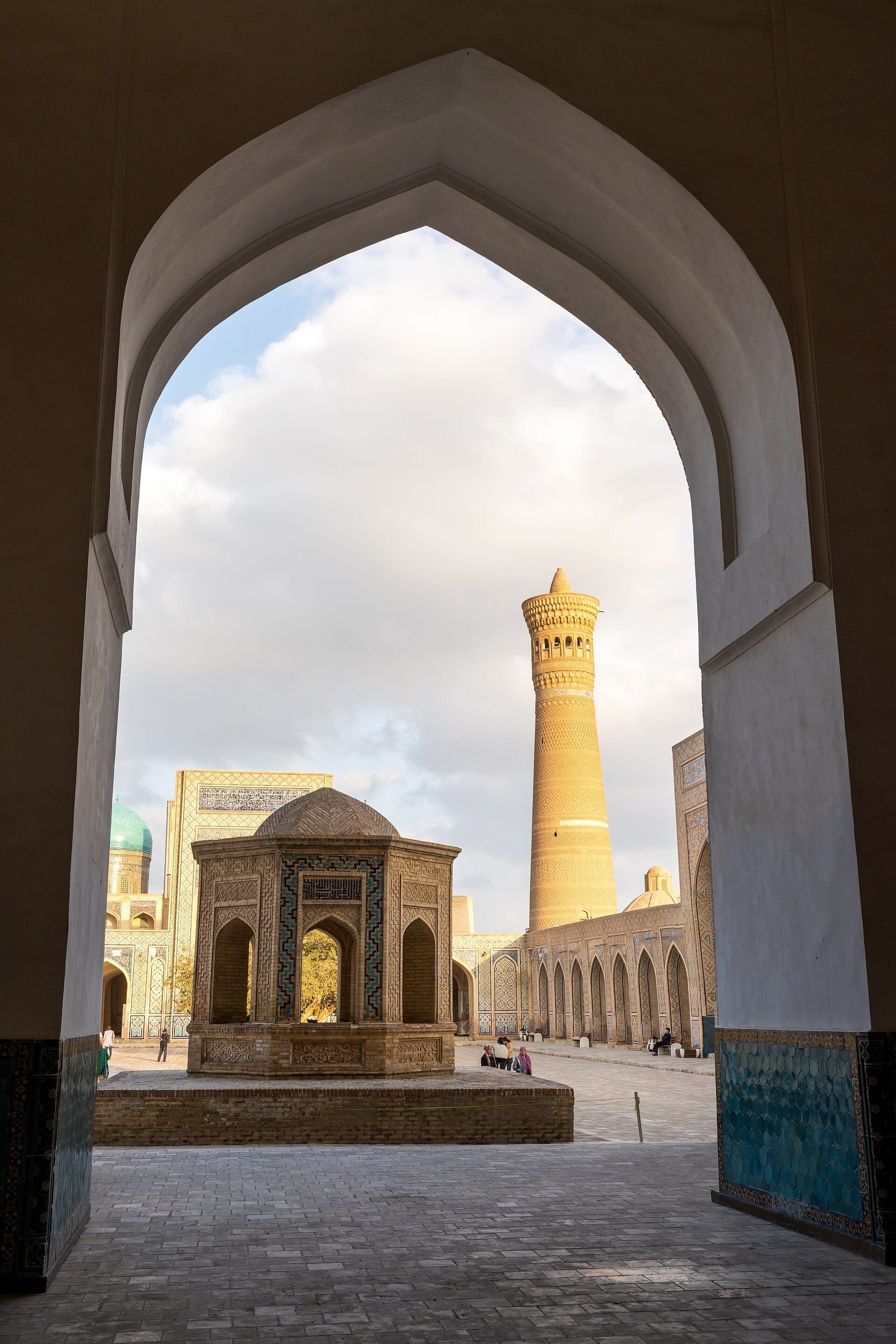
The simplest is banna’i, glazed bricks laid among plain ones so that the wall itself spells a pattern. The patterns are often words, the names of God and of the Prophet, or a short phrase of praise, repeated in a script square enough to be built and large enough to be read from the street. The twelfth-century Kalyan minaret in Bukhara is its older cousin, unglazed but for one narrow band of blue near the top, every band of it a different way of laying the same brick; the outer walls of Bibi-Khanym in Samarkand are banna’i proper.
The finest and costliest is mosaic faience. A tile of one colour was fired, then cut into a leaf, a letter or a sliver of a star, and the pieces were set in plaster like a jigsaw, the colours meeting at a sharp edge. Shah-i-Zinda and the portal of the Ulugh Beg madrasa are the places to see it. Stand close to a panel and look at the joints.
The third way is the painted tile, haft rangi, the seven colours: the pattern is drawn on a flat tile and the colours fired together, a dark line between them to keep them from running. It is quicker. The Timurids used it too, beside the mosaic, but it became the common method of the seventeenth century. From a distance it passes for mosaic; up close the line is softer and the surface is one plane.
The scripts
Two scripts do most of the talking. Kufic is the square, angular one, and the angles are the point: it can be built of bricks, so it is the script of the banna’i walls and of the drum under a dome. Thuluth is the flowing one, tall strokes and long curves, the script of the portals, where a verse runs up one side of the arch, across the top and down the other in white on blue.
Your guide can tell you what the verses say. Most are from the Qur’an; some name the patron and the date. Once in a while, in small letters among the inscriptions of a portal, the maker signed. Several Shah-i-Zinda façades carry a tile-cutter’s name, and having the guide point one out is among the pleasures of the stairway.
The motifs
The patterns come in two families. Girih is the geometry: stars and polygons drawn from a lattice, so that a ten-pointed star is ringed by pentagons and the pentagons by more stars, without end. The eight-pointed star, the khatam, is the one that recurs most. Islimi is the plant: the vine that climbs and splits and turns back on itself, carrying a flower at every turn.
Two Registan madrasas say something with their motifs. The portal of the Ulugh Beg madrasa, of the early fifteenth century, is a lattice of stars, and it is hard not to read it as a sign for the astronomer-prince who measured the sky from the hill above the city. Across the square the Sher-Dor, of the seventeenth century, carries over its arch two tigers chasing white deer, each with a sun on its back and a face in the sun. Living things were not supposed to appear on a religious building. They appear anyway, and the name of the madrasa records it: Sher-Dor, the one with the lions, or tigers, since the word serves for both and the beasts are striped.
What is old, and what is new
Much of the tile on the Registan is twentieth-century work, and the domes and minarets under it were restored; Bibi-Khanym, a ruin after an earthquake at the end of the nineteenth century, was largely rebuilt in the last decades of the twentieth. Minarets had leaned, domes had fallen, and much of the tile was gone. What you see is a restoration, done over decades on the pattern of what survived, and it is worth knowing which is which.
The restored tile is flatter, more even and brighter; the old tile has a glaze that has gone matt and pitted, and no two pieces are quite the same shade. Where the two meet there is a seam, and a guide who knows the building will show it to you. Shah-i-Zinda keeps more original work than the Registan, though it too has had its restorers; Tilya-Kori, of the seventeenth century, is much restored outside, and the gold within that gives it its name is largely restored too.
The hour
Glaze is a kind of glass, and it answers to the light. A portal that faces east, as the Ulugh Beg madrasa does, is at its best in the morning; its neighbour across the square waits for the afternoon. The Shah-i-Zinda stairway wants the low sun of late afternoon, when the light comes down the steps and the mosaic throws it back. At dusk the lamps come on at the Registan and the blue goes to black and gold. We plan a Samarkand day around these hours.
None of this takes long to learn. Two buildings looked at properly are worth ten passed through, and the guide reads them: where the mosaic ends, what the drum says, which star is which. Tell your travel designer that the buildings are the point, and the days will be planned around the light.