Samarkand
Blue domes over Timur’s capital
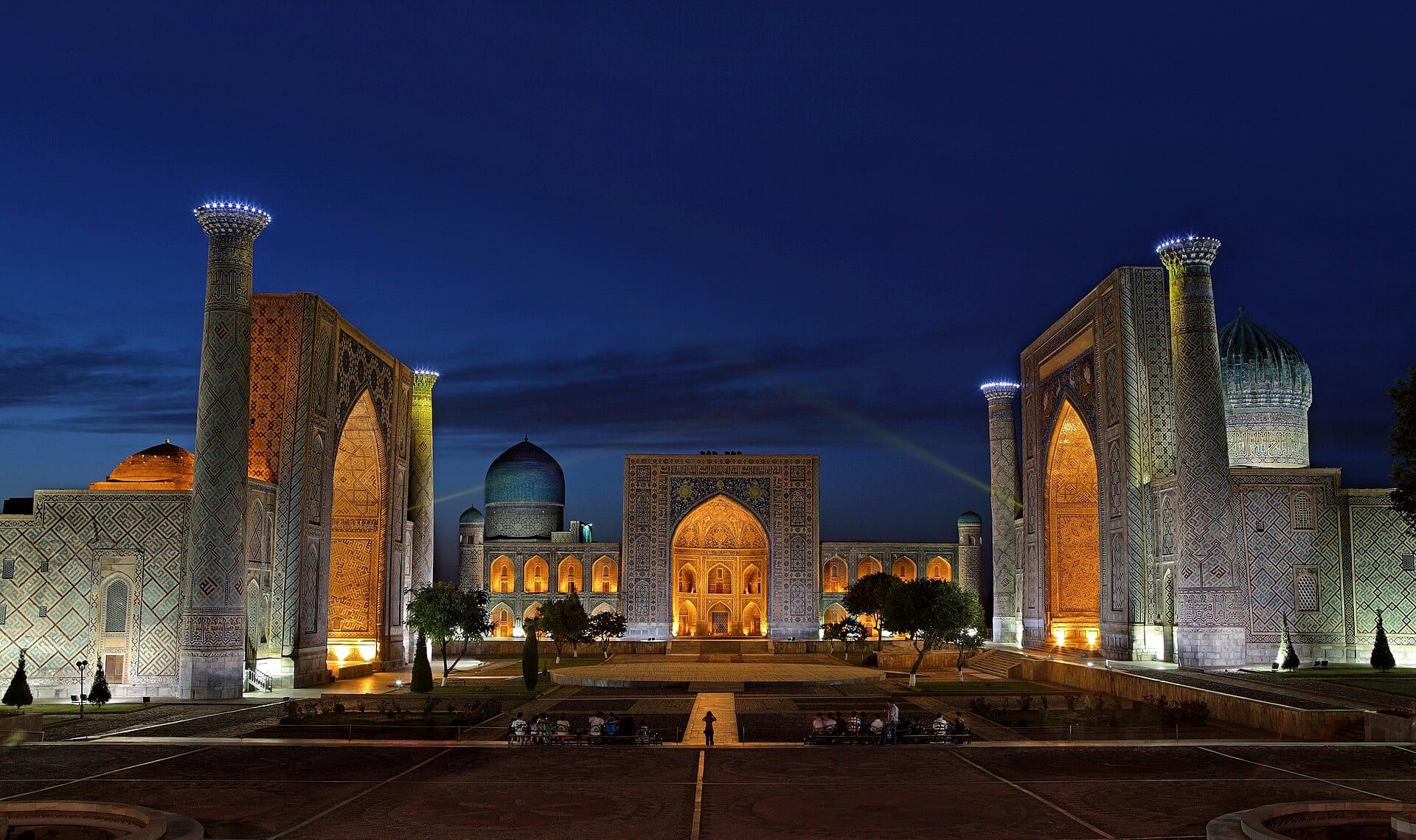
Timur’s capital and the most famous halt on the Silk Road. The blue domes and tiled portals of the Registan are the picture most people carry of Uzbekistan before they arrive.
Samarkand is the picture most people carry of Uzbekistan before they arrive, and the Registan does not disappoint it. Three madrasas face one another across a square, their portals tiled in blue, turquoise and gold, raised over two centuries from Ulugh Beg onwards. Come at dawn, when the square is empty and the tiles hold the first light, and come back in the evening, when the lamps are lit.
The city was Timur’s capital, and his buildings set the scale. Gur-e-Amir, where he lies beneath a ribbed turquoise dome, is small and intense; Bibi-Khanym, the mosque that bears his wife’s name, was once among the largest in the Islamic world. Along a narrow stairway on the slope of Afrosiab, the mausoleums of Shah-i-Zinda hold the finest tilework in the country, each façade a different answer to the same question. On a hill above the city, the remains of Ulugh Beg’s observatory record a prince who measured the stars.
Samarkand is a living city rather than a museum, and the best of it lies between the monuments: Siab Bazaar beside Bibi-Khanym, the shaded streets of the nineteenth-century town, a courtyard lunch of samsa and green tea. Two hours from Tashkent by the Afrosiyob train, it is the city we build most journeys around. Two nights is the minimum and three is better, with Shakhrisabz over the pass for the third day.
Journeys that go there
Silk Road Classic
The four great cities in one week: Tashkent, Khiva, Bukhara and Samarkand, with a day across the desert and high-speed trains between them.
The Grand Journey across Uzbekistan
The whole country in eleven days: all four Silk Road cities, a night in a yurt beside Lake Aydarkul and a day in Shakhrisabz, the town where Timur was born.
Samarkand and Bukhara Express
Four days for the two most celebrated cities of the Silk Road, Samarkand and Bukhara, with the high-speed train between them and time to look rather than hurry.
Nurata Yurt Escape
A two-day desert interlude between Samarkand and Bukhara: the sacred spring at Nurata, a camel ride and a night under the stars in a yurt camp by Lake Aydarkul.
Begin your journey
Tell us when you would like to travel and what you would like to see. One designer will reply within one working day.